

You stand in your yard, looking at the tangled green boundary wire from your old robot mower. It snags on garden tools, gets chewed by the dog, and takes hours to replace when it breaks. Yet you hear about newer models that navigate without any wire at all, using GPS satellites and cameras. Which path should you choose? This guide compares boundary wire and GPS navigation for robot mowers, using the Segway Navimow i105N as a prime example of the wire-free future. If you are shopping for a new robotic mower, check our roundup of the best robot lawn mowers for more options.
As an Amazon Associate, YardProven.com earns from qualifying purchases. We may also participate in other affiliate partner programs. Commission does not influence which products we cover or how we rank them.

Pros
- Revolutionary wire-free setup saves hours of installation compared to traditional robotic mowers
- Advanced AI mapping identifies lawn edges automatically, making boundary training intuitive and quick
- Exceptional performance under tree cover and complex yard layouts that defeat other robot mowers
- Extremely quiet operation at 58dB allows mowing at any time without disruption
- Comprehensive app control with multi-zone management and optional anti-theft GPS tracking
Cons
- Requires clear sky view for satellite signal reception, which can be challenging in heavily wooded or urban areas
- Initial boundary mapping requires walking the perimeter with remote control, which takes time and patience
- Not designed for overgrown or unmaintained grass, requires regular lawn conditioning
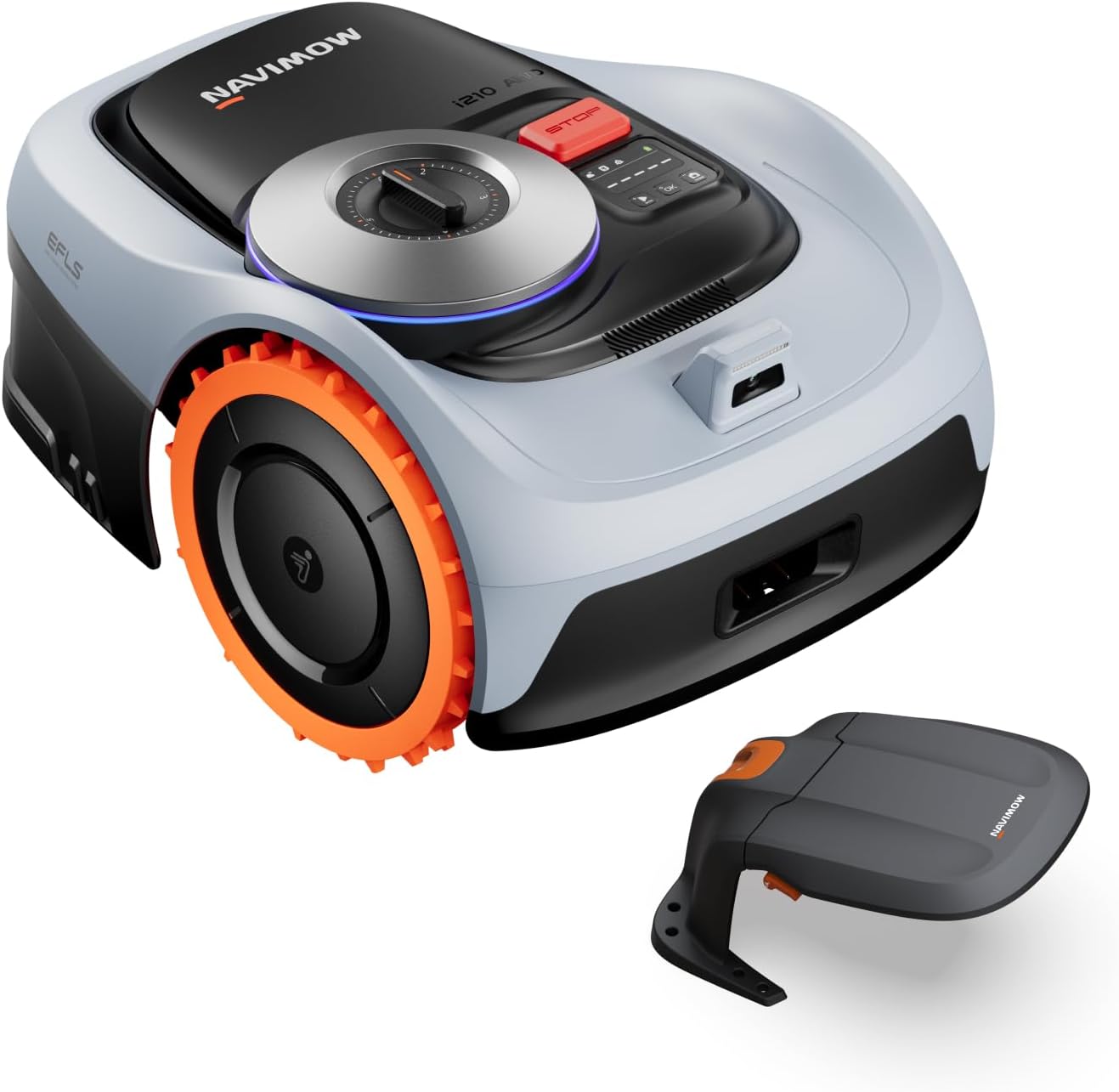
The Segway Navimow i105N represents a significant leap forward in robotic lawn mower technology. This wire-free autonomous mower is designed for homeowners with yards up to 1/8 acre who want the convenience of automated lawn care without the traditional hassle of installing perimeter boundary wires. The mower combines RTK satellite positioning with computer vision technology to navigate and maintain lawns intelligently.
What truly sets the Navimow i105N apart is its advanced navigation system. The RTK+Vision technology with EFLS 2.0 provides centimeter-level positioning accuracy, allowing it to work effectively even under tree canopy or in narrow passages where conventional robotic mowers struggle. The AI-assisted mapping feature automatically identifies lawn edges during initial setup, dramatically simplifying the boundary training process compared to competitors. The built-in 140-degree camera can detect over 150 types of obstacles, providing robust safety and obstacle avoidance.
The mower operates at an impressively quiet 58dB, making it one of the quietest options available. Its intelligent programming ensures systematic mowing patterns that minimize visible tracks on your lawn, automatically changes direction after full coverage, and handles recharging cycles autonomously until the entire lawn is cut. The comprehensive app offers multi-zone management for up to 12 different areas with independent schedules, remote control capabilities, and optional GPS anti-theft tracking.
Setup does require clear satellite visibility for optimal performance, which may present challenges in heavily wooded or urban environments with tall buildings. Initial boundary mapping involves walking the perimeter with remote control guidance, which some users find time-consuming but necessary for accuracy. The mower is also not suitable for severely overgrown grass and performs best on regularly maintained lawns.
For homeowners seeking a premium, wire-free robotic mowing solution that handles complex yard layouts with intelligence and quiet efficiency, the Navimow i105N delivers exceptional value and performance. Its advanced technology, comprehensive app ecosystem, and 3-year warranty make it a solid investment in lawn care automation.
Core Specifications:
Model: Segway Navimow i105N
Cutting Width: 7.1 inches
Coverage Area: Up to 1/8 acre (approximately 5,445 sq ft)
Cutting Height Range: 3.6 to 2 inches (5 adjustable positions)
Weight: 24 pounds
Dimensions: 21.5 inches D x 11.2 inches W x 15.2 inches H
Operation Mode: Fully automatic with app control
Power Source: Battery powered with intelligent auto-recharge
Noise Level: 58dB(A), among the quietest in class
Navigation: RTK+Vision with EFLS 2.0 technology, centimeter-level accuracy
Obstacle Detection: 140-degree camera detecting 150+ object types
Material: ASA and polypropylene construction
Available Colors: Grey, Black, Orange
Included Accessories: Power supply, extension cable with 10 pegs, charging station, GNSS antenna kit with installation components, 9 spare blades and bolts, installation kit, and user materials.
Warranty: Full 3-year manufacturer warranty with optional 4G anti-theft module available separately.
Pre-Installation Requirements:
Before beginning setup, ensure your yard has adequate satellite visibility for RTK signal reception. Position your GNSS antenna in a location with clear sky view, ideally elevated and away from large trees or buildings. The antenna placement is critical for optimal performance, so take time to find the best location before mounting permanently.
Installation Process:
Setup begins with the smartphone app, which guides you through the initial configuration. Use your phone to manually control the Navimow i105N around your lawn perimeter to establish virtual boundaries. The revolutionary AI-assisted mapping automatically identifies clear lawn edges during this process, significantly reducing the learning curve compared to traditional methods. Once boundary mapping is complete, the mower can operate autonomously with minimal intervention.
Pro Tips from Users:
Allow adequate time for the initial boundary walk, as rushing this step may require corrections later. If your yard has complex obstacles or irregular shapes, you may need to make map adjustments after the first few runs. Take advantage of the multi-zone feature to create separate mowing schedules for different lawn sections. Consider the optional antenna extension kit or explore budget-friendly mounting alternatives to achieve optimal satellite signal strength.
Buying Guide: Choosing Between Boundary Wire and GPS Robot Mowers
1. Setup Complexity: Wires vs. Instant Mapping
Boundary wire mowers require you to lay hundreds of feet of wire around your lawn perimeter, bury it, and connect it to a charging station. This process can take a full weekend and often needs adjustments as the wire shifts over time. GPS mowers like the Segway Navimow i105N cut this to minutes. You simply place the charging station, turn on the mower, and use the app to define virtual boundaries. The wire-free setup is a major reason many homeowners in 2026 are upgrading.
2. Navigation Accuracy: How Precise Is Each System?
Traditional boundary wire mowers follow the wire as a physical guide, which provides consistent edge detection but can drift after rain or soil movement. GPS mowers rely on satellite signals, but basic GPS can be off by several feet. The Segway Navimow i105N enhances GPS with RTK (Real-Time Kinematic) correction and a forward-facing camera (Vision). This combination delivers centimeter-level positioning, even under tree cover or in narrow corridors. For accurate, repeatable mowing patterns, GPS with RTK+Vision is now the superior choice.
3. Obstacle Avoidance: Sensors vs. AI Cameras
Boundary wire mowers typically rely on bump sensors or simple ultrasonic detectors. They hit objects, then back up. GPS mowers with AI cameras can see and identify obstacles before contact. The Navimow’s 140-degree camera recognizes over 150 types of objects, from toys to pets. This not only prevents collisions but also allows the mower to work autonomously while you relax. Our experts have assessed that AI-driven obstacle avoidance dramatically reduces manual interventions compared to wire-bound models.
4. Lawn Layout and Size Compatibility
Boundary wire systems work fine on simple, open lawns but struggle with complex shapes, narrow paths, or multiple zones. Each zone requires a separate wire loop and often a second charger. GPS mowers handle complexity naturally. The Segway Navimow i105N supports up to 12 zones in the app, each with its own schedule and mowing direction. Its AI mapping automatically identifies lawn edges and fills in the entire area. If your yard has trees, flower beds, or irregular borders, the wire-free GPS approach is far more practical. For more on robot mower categories, visit our robot lawn mowers page.
Final Thoughts
After evaluating both navigation methods, the clear winner for modern yards is the GPS-based wire-free system. The Segway Navimow i105N Robot Lawn Mower Perimeter delivers effortless setup, centimeter-precision cutting, and intelligent obstacle avoidance that wire-based mowers simply cannot match. Whether you have a simple lawn or a complex garden with multiple zones, this mower handles it all without a single foot of boundary wire. For those who prefer not to mess with wires and want a smarter, quieter mowing experience, the Navimow i105N is the recommendation for 2026.
Frequently Asked Questions
Can a GPS robot mower work under trees?
Yes, if the mower uses RTK+Vision like the Segway Navimow i105N. The RTK correction maintains strong GPS lock even under dense foliage, while the camera helps with local navigation. Basic GPS mowers may lose signal under heavy canopy, so look for hybrid systems.
Do wire-free robot mowers need internet?
Most require an internet connection for initial map creation and app control. The Segway Navimow i105N uses Wi-Fi for the app and optional 4G for anti-theft tracking. Once mapped, the mower can operate independently without constant internet, but you will need connectivity to manage schedules and updates.
How long does it take to set up a robot mower without boundary wire?
Setup for a GPS mower like the Navimow takes about 15 to 30 minutes. You place the charging station, connect power, and guide the mower through the app to define virtual boundaries. The AI-assisted mapping then completes the lawn map automatically, saving hours compared to traditional wire installation.
Are boundary wire robot mowers still worth buying in 2026?
If you have a very small, simple lawn and a tight budget, a wire-based mower can still work. However, wire-free models have dropped in price and offer far greater convenience, accuracy, and safety. For most homeowners, the extra flexibility of GPS navigation justifies the small premium. Check our robot mower category page for a full comparison of both types.



Write Your Review
No reviews yet. Be the first to share your experience!