

You have a large driveway, patio, or concrete sidewalk that needs cleaning. Using a standard pressure washer nozzle is tedious, leaves tiger stripes, and takes forever. A surface cleaner attachment spins two high-pressure jets under a shroud, cleaning evenly and quickly. But not all surface cleaners work well with every pressure washer. In this guide, we review the best pressure washer for a surface cleaner in 2026, covering standalone attachments and complete washer-and-cleaner bundles. Whether you need a compact unit for a small deck or a heavy-duty commercial-grade tool for a long driveway, we have you covered. For more on pressure washer basics, check out our pressure washer category page.


Buying Guide: What to Look for in a Pressure Washer Surface Cleaner
Surface Cleaner Width
The cleaning width directly affects how fast you finish. Smaller units (12–16 inches) work well for patios, walkways, and decks. Larger models (18–30 inches) cut cleaning time on big driveways and commercial surfaces. Match the width to your typical job size. Just as choosing the right deck size matters for your mower, selecting the correct surface cleaner width improves efficiency. Learn more about deck sizing in our 48 vs 54 inch zero turn mower.
PSI and Flow Rate Compatibility
Every surface cleaner has a maximum PSI rating. If your pressure washer exceeds that, you risk damaging the unit. Most attachments handle up to 4000–4500 PSI. Also consider the flow rate (GPM). High-flow cleaners (4 GPM and above) need a compatible washer to perform. Electric pressure washers typically output 1.1–1.4 GPM, while gas models deliver 2.5–4 GPM. Choose a surface cleaner that matches your washer’s output.
Build Quality and Materials
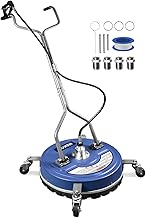
Look for a stainless steel housing and brass fittings. Stainless steel resists rust and impacts, lasting longer than plastic. A steel shroud also protects the spinning bar from debris. Models with dual handles and large wheels are easier to maneuver on rough concrete. The Stainless Steel Body, Dual Handles unit is a popular choice for its durability and smooth rolling.
Nozzle Configuration and Replacement
Most surface cleaners use two fixed nozzles that spin. Some models include extra nozzles or allow you to swap them for different spray patterns. Replaceable nozzles extend the life of the tool. Also check if the unit comes with a quick-connect adapter for easy attachment to your wand. A well-designed nozzle system prevents streaks and ensures even cleaning. For more buying tips, see our zero turn mower buying guide: the same principles of matching equipment to your property apply.
Final Thoughts
After reviewing dozens of models, we recommend two standout options for different needs. For homeowners with an electric pressure washer, the Greenworks 2000 Max PSI @ 1.1 GPM (13 Amp) bundle includes a surface cleaner attachment and delivers reliable performance for driveways and patios. If you have a gas washer and need a heavy-duty attachment, the Dual-Handle Power Washer Attachment for Large model offers a wide 20-inch cleaning path, stainless steel construction, and smooth rolling wheels. Either way, a quality surface cleaner will cut your cleaning time in half and leave a streak-free finish. Check the comparison table above for more options that fit your budget and washer specs.
Frequently Asked Questions
What size surface cleaner do I need for my driveway?
For a standard two-car driveway (about 400–500 sq ft), an 18- to 20-inch surface cleaner works well. Larger driveways benefit from 24- to 30-inch models. Match the width to your pressure washer’s flow rate: higher GPM supports wider cleaners.
Can I use a surface cleaner with an electric pressure washer?
Yes, many surface cleaners are designed for electric washers. Look for models rated for 2000–3000 PSI and 1.1–1.4 GPM. The Greenworks Pro 2300 Max PSI Brushless Electric unit is a complete solution that pairs a brushless motor with a surface cleaner attachment.
How do I prevent streaks when using a surface cleaner?
Streaks usually occur from moving too fast or using too much pressure. Keep the cleaner flat on the surface and overlap each pass by about 50%. Use a consistent speed and let the spinning jets do the work. Pre-treating oil stains with a degreaser also helps.
Do I need a special pressure washer for a surface cleaner?
No, most surface cleaners attach to any pressure washer with a standard 1/4-inch quick-connect. However, you need a washer that delivers enough flow to spin the cleaner. Electric washers with at least 1.1 GPM work fine for smaller units. Gas washers with 2.5+ GPM are better for commercial-grade cleaners. For more on equipment matching, read our fabricated vs stamped mower deck: the concept of choosing the right tool for the job is similar.




Write Your Review
No reviews yet. Be the first to share your experience!