

It is 2 p.m., the sun is blazing, and your RV’s air conditioner has been cycling on and off because the campground power pedestal keeps tripping. The remote campsite you planned for has no hookups, and the only way to keep things cool is to bring your own power. A reliable generator is the answer.
This guide focuses on the best generator for an RV air conditioner in 2026. We evaluated ten portable models, from compact inverter units to high-output dual fuel home backup machines, and looked at starting watts, fuel flexibility, noise level, and RV-ready outlets. If you are also investing in outdoor power gear, our zero-turn mower buying guide covers a similar decision process. For larger properties, the 54 vs 60 inch zero turn mower guide also helps you size your equipment.
Safety note: Fuel-burning generators produce carbon monoxide (CO), an odorless, colorless gas that the U.S. Consumer Product Safety Commission (CPSC) warns can kill in minutes. Never run a generator indoors or in a garage, basement, crawl space, or shed, even with doors or windows open. Operate it outdoors, far from doors, windows, and vents, and install battery-operated CO alarms in your home. To power household circuits, use a transfer switch installed by a licensed electrician instead of back-feeding through an outlet.

Pros
- High peak wattage for starting large appliances like AC and sump pump.
- Dual fuel capability offers fuel flexibility in emergencies.
- Remote start key fob adds convenience from a distance.
- CO sensor enhances safety by shutting down automatically when needed.
- Backed by a 3-year limited warranty and lifetime technical support.
Cons
- Heavy at 230 pounds, may require two people to move.
- Propane output is slightly lower than gasoline (peak watts reduce).
- Automatic transfer switch sold separately, adding to overall cost.
The Westinghouse WGen10500DFc is a robust dual fuel portable generator designed for home backup and job site power. With 13,500 peak watts and 10,500 running watts on gasoline, it can handle essential appliances like refrigerators, air conditioners, and sump pumps simultaneously. This generator is ideal for homeowners who want reliable power during outages and value fuel flexibility.
Standout features include the push-button electric start and remote key fob, which make operation effortless even in bad weather. The dual fuel capability lets you switch between gasoline and propane, ensuring you have options when one fuel is scarce. The 9.5-gallon tank provides up to 19 hours of runtime at 25% load, reducing refueling frequency during long outages.
Build quality is solid with a 500cc cast iron sleeve engine and pressure lubrication for longevity. The included never-flat wheels and fold-down handle make it easier to move, though at 230 pounds it is still heavy. The control panel is well laid out with 50A and 30A outlets ready for transfer switch or interlock kit connection, simplifying home integration.
Potential drawbacks include the weight, which may require assistance to position, and the slightly lower output when running on propane. The automatic transfer switch is sold separately, so budgeting for that is necessary for full automatic backup. The CO sensor adds a critical safety layer but may cause occasional false triggers in confined spaces.
Overall, the Westinghouse WGen10500DFc delivers exceptional power, fuel flexibility, and convenience features at a competitive price. Its reliable engine and safety extras make it a smart investment for anyone serious about home backup power. Backed by a 3-year warranty and lifetime support, it stands out as a top performer in its class.

Pros
- Dual fuel capability provides fuel flexibility and longer runtime options.
- CO sensor enhances safety during indoor or enclosed use (always operate outdoors).
- Multiple outlets (including RV and transfer switch ready) cover a wide range of backup scenarios.
- Easy to assemble and start, with positive user reviews for reliability.
- Strong value for the price compared to similar dual-fuel generators.
Cons
- At 135.6 pounds, it is heavy to move without the wheels, though the built-in wheels help.
- No remote start or electric start; relies on manual recoil pull start (though users report it starts easily).
- Noise level is moderate but typical for an open-frame generator; may not be ideal for quiet neighborhoods.
The Westinghouse WGen5300DFcv is a dual fuel portable generator designed for homeowners, RVers, and anyone needing reliable backup power during outages. With 5300 running watts (6500 peak) on gasoline and 4800 running watts (5800 peak) on propane, it can power essential appliances like refrigerators, sump pumps, lights, and even RV air conditioners. Its CO sensor, transfer switch readiness, and multiple outlets make it a versatile and safety-conscious choice.
Performance is where this generator shines. The 274cc Westinghouse engine with a cast iron sleeve is built for durability, and users confirm it starts easily and runs smoothly. The automatic low oil shutdown and CO sensor add layers of protection. Real-world reviews highlight its ability to run a fridge, freezer, and electronics for hours, with run times up to 14.5 hours on a 4.7-gallon gas tank. Switching to propane extends runtime further, though peak wattage drops slightly.
Design and build quality are solid for the price point. The hardened steel frame and foam-filled never-flat wheels make it rugged and relatively easy to maneuver on flat ground. The control panel is well laid out with rubber-covered outlets and a built-in fuel gauge. Some users received units with minor cosmetic dents from shipping, but the generator itself performed flawlessly. Assembly is minimal thanks to included tools and an oil funnel.
Drawbacks include its weight (135.6 lbs) and lack of electric start, though the manual pull start is generally reliable. Noise is moderate, typical for an open-frame generator, so it may not suit camping sites with strict noise limits. Additionally, the unit is EPA compliant but not CARB approved, which limits sales in California.
Overall, the Westinghouse WGen5300DFcv offers an excellent balance of power, fuel flexibility, safety features, and value. It is ideal for homeowners on a budget who want a backup generator that can handle critical loads for days. Backed by a 3-year warranty and strong customer support, it is a dependable investment for peace of mind.
Running Watts: 5300 (gasoline) / 4800 (propane)
Peak Watts: 6500 (gasoline) / 5800 (propane)
Engine: 274cc Westinghouse 4-Stroke OHV with cast iron sleeve
Fuel Tank: 4.7 gallons with fuel gauge
Run Time: Up to 14.5 hours (gasoline at 50% load)
Outlets: One 5-20R 120V duplex, one TT-30R 30A RV, one L14-30R 30A transfer switch ready
Weight: 135.6 pounds
Dimensions: 23.2 x 20.1 x 19.1 inches
Warranty: 3-Year Limited

Pros
- Excellent power output for whole-home backup; runs essential appliances simultaneously.
- Dual fuel capability provides fuel choice and longer runtimes during shortages.
- Remote and electric start make it easy to use from inside or at a distance.
- Rugged construction with cast iron engine and never-flat wheels for portability.
- Comes with comprehensive kit: battery charger, oil, funnel, propane hose, and remote fob.
Cons
- Heavy at over 200 pounds, moving it may require two people despite wheels.
- Noisy operation typical of open-frame generators; not ideal for quiet neighborhoods.
- Propane runtime is shorter than gasoline; fuel consumption is high under full load.
The Westinghouse WGen9500DF is a dual fuel portable generator designed for homeowners who need reliable backup power during outages or for off-grid use. With 12500 peak watts on gasoline and 11200 on propane, it can handle heavy loads like air conditioners, well pumps, and refrigerators simultaneously.
Standout features include remote start via key fob, push-button electric start, and a VFT display that shows voltage, frequency, and hours. The transfer switch-ready outlets (L14-30R and 14-50R) allow direct connection to a home panel, making it a true backup solution. Runtime reaches up to 12 hours on a 6.6-gallon gas tank, though it's shorter on propane.
Build quality is robust: a 457cc OHV engine with a cast iron sleeve ensures longevity, while the steel frame and never-flat wheels aid portability. Included accessories like a battery charger, oil, and propane hose add value. However, the generator is heavy and noisy, which may limit placement options near living spaces.
Potential drawbacks include weight (over 200 pounds) and noise levels typical of open-frame units. Also, propane runtime is less than gas, and fuel consumption at full load is high. These are common trade-offs for a high-power generator.
Overall, the Westinghouse WGen9500DF is an excellent choice for homeowners seeking a powerful, dual-fuel generator with convenient starting and transfer switch compatibility. Its performance and features justify its price for serious emergency preparedness.

Pros
- Produces clean, stable power ideal for sensitive electronics
- Lightweight and portable at just 56 pounds
- Long runtime of up to 14 hours with ECO mode
- Multiple outlets including 30A RV port for versatile use
- Easy to start (often first or second pull) and low maintenance
Cons
- Noise level is high (around 100 dB close up, 75 dB at 30 feet) compared to enclosed inverters
- Lacks an ignition switch; must use pull cord to shut off
- Some users report actual wattage peaks near 3000 watts despite 4400 rating, so consider load limits
The Oxseryn 4400-Watt Inverter Generator offers a compelling blend of power, portability, and affordability for homeowners, campers, and RV enthusiasts. With a peak output of 4400 watts and 3400 running watts, it can handle essential appliances, power tools, or recreational gear with ease.
Its inverter technology delivers clean, stable power safe for sensitive electronics like laptops and refrigerators. The dedicated 30A RV outlet makes it a convenient companion for road trips, while ECO mode extends runtime up to 14 hours on a single tank of gas.
Despite its open-frame design, the generator is remarkably lightweight at just 56 pounds, featuring a built-in handle for easy maneuvering. Cold start technology ensures reliable first-pull starts, and low oil shutdown adds engine protection for peace of mind.
However, users note that it is not whisper-quiet; noise levels around 100 decibels close up mean it is best used outdoors or at a distance. Some also report that real-world output may max out near 3000 watts, so consider your loads accordingly. Additionally, the unit lacks an ignition switch, requiring the pull cord for shutdown.
Overall, for its price point, the Oxseryn 4400W inverter generator delivers solid performance, excellent fuel economy, and the versatility needed for emergency backup, camping, or light job site use. It is a practical choice for budget-conscious buyers who prioritize portability and clean power.

Pros
- Lightweight and portable at under 49 pounds.
- Reliable cold start technology for quick starts in cold weather.
- Clean power for sensitive electronics.
- Quiet operation suitable for camping and tailgating.
- Includes multiple outlet types including RV-ready TT-30R.
Cons
- Not recommended for whole-home emergency backup due to limited running watts (3000).
- Some users report it is slightly louder than other inverter generators in its class.
- Oil capacity is only 0.5 quarts, requiring more frequent checks.
The Champion 4000-Watt Portable Inverter Generator (model 100809) is a lightweight, RV-ready power solution designed for camping, tailgating, and basic backup needs. With 4000 starting watts and 3000 running watts, it provides enough power to run a RV air conditioner, small appliances, or sensitive electronics. Its standout feature is being one of the lightest 4000-watt inverters on the market at under 49 pounds, making it easy to take on the go.
Real-world performance from customer reviews highlights its reliability and clean power output. Users report using it to run 12000 BTU air conditioners without ECO mode struggling, and it handles multiple devices like TVs, fans, and refrigerators with ease. The Cold Start Technology ensures quick starts even in cold weather, and the Economy Mode helps extend runtime up to 10 hours on a single tank of gas, saving fuel and reducing noise.
The generator features a durable design with a built-in carrying handle and a compact footprint. It includes a TT-30R RV outlet, a household duplex outlet, and a 12V automotive port, plus parallel outlets for combining with a second unit. Safety is prioritized with CO Shield technology that automatically shuts off the engine if dangerous carbon monoxide levels are detected, meeting ANSI/PGMA G300-2018 standards.
One potential drawback is that this model is not intended for whole-home emergency backup, as its running wattage is limited to 3000 watts. Some users note that at 64 dBA, it is slightly noisier than some premium inverter generators, though still quiet enough for camping. The oil capacity is only 0.5 quarts, so frequent checks are needed during long use.
Overall, the Champion 4000-Watt Inverter Generator offers excellent value for campers, RVers, and tailgaters who need portable, clean power. Its lightweight build, safety features, and user-friendly controls make it a top choice in its class, backed by a 3-year warranty and free lifetime technical support.

Pros
- Incredible value for the price, outperforming many more expensive brands
- Lightweight and easy to transport (56 lbs) with a compact footprint
- Long runtime of up to 14 hours at 25% load, saving on fuel costs
- Quiet enough for nighttime use in camper or residential areas
- Multiple outlets including an RV port for direct camper hookup
Cons
- Exhaust noise can be louder than expected when under heavy load
- Fuel tank could be larger, potentially requiring refueling during extended overnight use
- Some units may arrive with loose bolts that need tightening before first use
The Oxseryn EDOG10 is an inverter generator that delivers 4400 peak watts and 3400 running watts, making it a versatile power source for RV camping, tailgating, or home backup during outages. Its gas-powered, open frame design prioritizes affordability and portability without skimping on essential features. Priced well below many competitors, it aims to provide reliable energy for those who need a budget-friendly solution.
Standout features include ECO mode, which extends runtime up to 14 hours at 25% load, and multiple outlets including two 120V AC ports, a 12V DC port, and an RV-ready port. Real-world performance from over 800 customer reviews highlights its fuel efficiency and ability to power refrigerators, AC units, and tools. The quiet operation at under 72 dBA ensures it won't disturb neighbors or campsites.
Design and build quality are solid for its price point. At 56 pounds, it's one of the lightest 4400-watt generators available, with a metal frame that withstands transport. The fuel gauge, cold start technology, and low oil shutdown add convenience and safety. However, some users note that the exhaust can be louder than expected when under load, and a few report loosened bolts upon arrival.
Drawbacks include a relatively small 2-gallon fuel tank, which may require early morning refueling when running high-draw appliances all night. Also, while the noise level is generally low, it's not as whisper-quiet as premium inverter models. These are minor compromises given the significant cost savings.
Overall, the Oxseryn EDOG10 offers exceptional value for anyone needing a portable generator for camping or emergency home backup. Its power, efficiency, and lightweight design make it a smart choice for budget-conscious buyers who don't want to sacrifice performance. With proper initial checks, it's a reliable workhorse that outperforms its price tag.

Pros
- Quiet operation for its power class, ideal for campgrounds and residential areas
- Dual fuel capability provides fuel flexibility and longer run times (up to 12 hours on a 20 lb propane tank per reviews)
- Bonded-neutral 240V outlet enables Level 2 EV charging, a unique feature for portable generators
- Electric start makes startup effortless; recoil backup ensures reliability
- Strong customer satisfaction (4.4 stars) with consistent praise for power output and RV compatibility
Cons
- Only two 120V standard outlets may be limiting for users with many devices
- Consumes gasoline relatively quickly at higher loads; propane offers longer runtime but less peak wattage
- A few users report reliability issues (e.g., no-spark after extended use), though warranty support is available
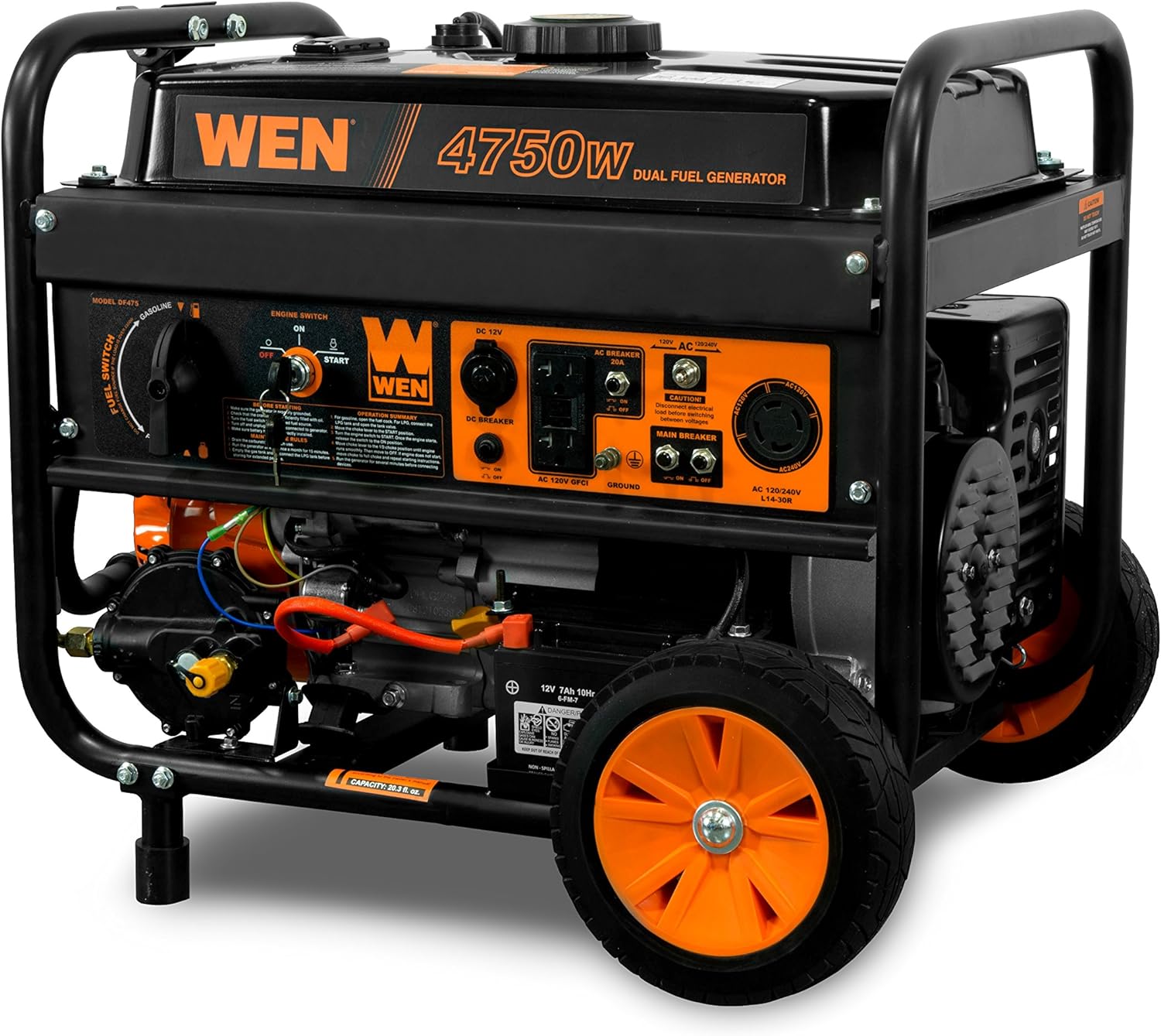
The WEN DF680iX is a 6800-watt dual fuel inverter generator designed for RV owners, campers, and those needing backup power for sensitive electronics or even electric vehicles. It combines the convenience of electric start with the safety of a CO watchdog sensor and the longevity of a fuel shutoff system. This generator is particularly appealing for those who want quiet, clean power in a portable package.
Standout features include its bonded-neutral 240V L14-30R outlet, which provides low-power Level 2 charging for battery electric and hybrid vehicles, making it a future-ready choice. Real-world performance is strong: users report it can handle two 15,000 BTU RV air conditioners plus lights and fans on propane, and it runs approximately 12 hours on a standard 20-pound LPG tank. The inverter technology keeps total harmonic distortion under 1.2% at full load, ensuring safe power for laptops and phones.
Build quality is solid with a 224cc engine, a 2.9-gallon fuel tank providing up to 6.1 hours at half load on gasoline, and a noise level of just 64 dB at quarter load. The telescoping handle and wheels make moving the 99-pound unit manageable, though it is still heavy. The panel includes eight outlets, including USB ports, a 12V DC receptacle, and a transfer switch-ready 240V plug.
Drawbacks are minor but worth noting: the generator has only two 120V standard outlets, so heavy users may need a power strip or splitter. Fuel efficiency on gasoline is moderate, and a few users have encountered spark issues after extended use, though the three-year warranty and customer service provide peace of mind. The propane quick-connect is convenient, but the included regulator hose length may limit placement.
Overall, the WEN DF680iX offers excellent value for RVers, EV owners, and home backup users who need quiet, clean, and flexible power. Its dual fuel capability, safety features, and quiet operation make it a strong contender in its class. If you prioritize low noise, clean power for electronics, and EV charging readiness, this generator is a smart investment.
Pros
- Dual fuel flexibility allows use of gasoline or propane depending on availability and cost.
- Remote and electric start provide convenience, especially in cold or emergency situations.
- Quiet operation at 52 dBA makes it suitable for noise-sensitive environments.
- Clean power under 3% THD protects sensitive electronics from damage.
- Long runtime up to 18 hours on gasoline reduces refueling frequency.
Cons
- Heavy at 104.7 pounds, requiring effort to move despite wheels and handle.
- Propane run time is shorter than gasoline, reducing overall runtime on propane.
- Some users report a brief break-in period where performance may vary initially.
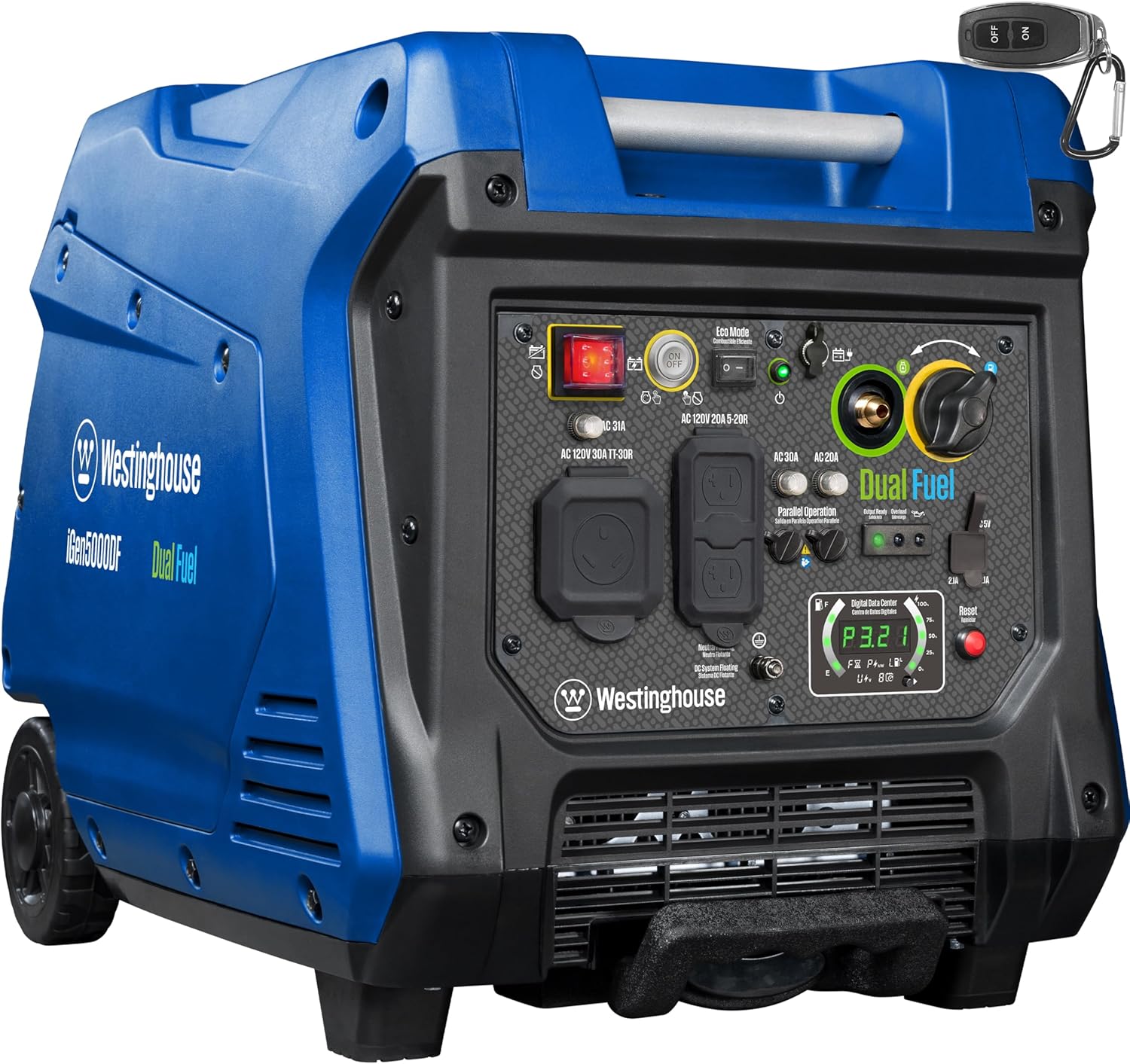
The Westinghouse iGen5000DF is a dual fuel inverter generator designed for recreational and emergency backup power. It delivers 5000 peak watts and 3900 rated watts with less than 3% total harmonic distortion, making it safe for sensitive electronics. Ideal for RV camping, tailgating, or home standby, it offers versatile fuel options and quiet operation.
Standout features include remote start via key fob, electric start, and a recoil backup. The generator runs up to 18 hours on a 3.4-gallon gas tank and supports propane for extended fuel flexibility. The LED data center shows fuel level, power output, run time, and voltage, keeping you informed at a glance.
Build quality is robust with a steel frame, aluminum components, and a compact design. The telescoping handle and wheels make it easier to move than traditional generators, though at 104.7 pounds it still requires some effort. Noise output is a low 52 dBA, comparable to a quiet conversation.
Potential drawbacks include weight and reduced runtime on propane. Some users mention a short break-in period. The generator is EPA compliant and backed by a 3-year limited warranty with nationwide service support.
Overall, the Westinghouse iGen5000DF is a reliable, quiet, and feature-rich dual fuel inverter generator. It excels in providing clean power for sensitive devices and offers the convenience of remote start. For RV owners, campers, and those seeking emergency backup, it is a strong choice.

Pros
- Exceptionally quiet operation, quieter than many comparable Honda models per customer reviews
- Lightweight and portable at under 50 pounds, easy to carry and store
- Clean power output protects sensitive electronics from damage
- Reliable starting even in cold weather, with easy pull start and low-oil shutoff
Cons
- Rated runtime of 5 hours at half load may require refueling for extended use
- Not powerful enough for larger appliances or heavy-duty tools beyond 2900 running watts
- May need to start in standard mode instead of eco-mode for consistent first pulls in cold conditions
The WEN 56360i is a 3600-watt portable inverter generator designed for campers, RV owners, and anyone needing reliable backup power. With 2900 rated watts and 3600 surge watts, it can handle essentials like RV air conditioners, refrigerators, and electronics, all while remaining quiet and lightweight.
Its inverter technology delivers clean sine wave power with less than 1.2% total harmonic distortion, so you can safely plug in laptops and phones. Real-world performance from user reviews shows it starts easily (even in 14°F weather) and runs a 13,000 BTU air conditioner without issue. The 65 dB noise level is impressively low, with one reviewer noting it is quieter than a Honda 3600.
The generator weighs just 46 pounds and features a built-in handle, making it easy to move around. The fuel shutoff carburetor drain prolongs engine life by preventing stale fuel buildup. A TT-30R RV receptacle, two 120V outlets, and two USB ports cover most power needs. Eco-mode automatically reduces engine speed when load is low, saving fuel.
Drawbacks include a 1.6-gallon tank that provides about 5 hours of runtime at half load, which may be short for overnight use. Some users note it is not powerful enough for larger tools or appliances over 2900 watts. A few found that starting in standard mode (not eco) works best in cold weather.
Overall, the WEN 56360i offers exceptional value for its price, combining quiet operation, clean power, and portability. It is ideal for RV trips, camping, and emergency backup for essential devices. Backed by a 3-year warranty and positive customer reviews, this generator is a strong contender in its class.

Pros
- Dual fuel flexibility for extended use and fuel availability.
- High peak wattage handles startup loads like air conditioners.
- Safety features including CO sensor and low oil shutdown.
- Easy to start with reliable pull-start mechanism.
- Quiet operation as noted in user reviews.
Cons
- No electric start, requires manual pull-start.
- Heavy at 108 pounds, may be difficult to move without wheels.
- Some users report minor fuel odor initially due to factory testing.
The Westinghouse WGen3600DFcv is a dual fuel portable generator designed for both RV enthusiasts and homeowners needing backup power. With 4650 peak watts on gasoline and 4180 on propane, it provides enough juice to run essential appliances like refrigerators, lights, and even a 15,000 BTU air conditioner. Its dual fuel capability allows seamless switching between gas and propane without shutting down, offering flexibility during emergencies or camping trips.
Real-world performance is impressive, as evidenced by user reviews praising its reliability during extended power outages. One reviewer ran it non-stop for over 72 hours, powering an entire 1,400-square-foot home with ease. Starting is straightforward, with most users reporting a quick pull-start on the first or second try, especially when using propane. The generator runs quietly, making it suitable for residential areas.
Build quality is solid with a 212cc Westinghouse engine featuring a cast iron sleeve for durability. The control panel includes rubber outlet covers to protect against dust and debris, plus a digital readout for monitoring voltage, frequency, and runtime. Safety features like the CO sensor and automatic low oil shutdown add peace of mind. The included accessories, such as oil, funnel, tool kit, and propane hose, make setup a breeze.
Potential drawbacks include the lack of an electric start, which may be a consideration for those who prefer push-button convenience. At 108 pounds, the generator is heavy and not easily portable without a wheel kit (sold separately). Some users note a slight fuel odor initially due to factory testing, but this dissipates quickly. Additionally, the runtime on propane, while decent, could be longer for extended off-grid use.
Overall, the Westinghouse WGen3600DFcv offers excellent value for its price, combining dual fuel versatility, sufficient power, and essential safety features. It is ideal for RV owners, homeowners seeking backup power, or anyone needing a reliable generator for outdoor events. With a 3-year warranty and strong customer support, it is a dependable choice that outperforms expectations.


Pros
- Very quiet operation at 50 dB, much quieter than standard RV AC units, as confirmed by multiple user reviews.
- Low power consumption (approximately 5275 watts max, but variable speed adjusts usage) and battery saver mode enable extended off-grid use.
- Easy installation process, typically completed in under an hour, with all necessary hardware and foam seal included.
- Effective cooling performance even in high heat, quickly bringing down interior temperature in large RVs (e.g., 31-foot trailer).
- Built-in soft start avoids voltage drops that can trip inverters or generators, and works with GFCI outlets when using quality receptacles.
Cons
- Unit does not include a heat pump for winter heating, so a separate heating solution may be needed.
- Some users have reported defective control boards or parts availability issues under warranty, though most reviews are positive.
- Requires purchase of separate adapter duct box (ADB) for complete installation, adding to the overall cost.
The Furrion Chill Cube 18K Non-Ducted Rooftop RV AC (model FACR18VS-SA-PS-AM) is a game-changer for RV owners who want powerful cooling without the roar of traditional units. With variable speed compressors, this air conditioner runs continuously and smoothly adjusts its output to maintain the set temperature, eliminating the jarring on-off cycles that disturb peace and spike power use. It is ideal for anyone from weekend campers to full-time travelers who value whisper-quiet operation and energy efficiency.
Boasting 18,000 BTUs of cooling power, the Chill Cube can handle soaring outdoor temperatures up to 105°F, cooling down a 16-foot travel trailer or a mid-sized motorhome quickly. Real-world reviews highlight that it cools a 31-foot Airstream in about 15 minutes on a hot day. The variable speed technology also keeps amp draw as low as necessary, which is perfect for battery-powered or solar setups, and even a Honda EU2200 generator can run it with ease.
Design-wise, Furrion kept weight down to just 72.4 pounds, about 10% lighter than many competitors, and shaped the top to reduce aerodynamic drag. Installation is straightforward with a bolt-on method, and the included foam seal makes sealing a breeze. The unit comes only as the AC head, so you will need the optional ADB kit (sold separately) for the interior distribution box. Controls are via a simple remote, and the battery saver mode lets you cap power at 50% or 75% to conserve energy.
There are a few potential downsides to consider. First, this version does not include a heat pump, so winter camping requires a separate heater. Second, while the majority of reviews are glowing, a small number of customers have experienced control board failures and reported difficulty obtaining replacement parts under warranty. This is a risk worth weighing, but given the overall high rating of 4.4 stars, these cases appear to be outliers. Also, budget for the additional ADB (around $50-100) if you do not already have one.
In verdict, the Furrion Chill Cube 18K RV AC is an excellent investment for anyone seeking quiet, efficient, and powerful air conditioning in their RV. It excels in performance, ease of installation, and low power consumption, making it a top contender in the non-ducted market. If you can deal with the lack of heat pump and occasional QC concerns, this unit delivers exceptional value for the price.

Pros
- Allows smaller generator to power large AC and other electronics
- Reduces risk of tripped breakers in RV parks or home hookups
- Smooth, quiet compressor start with less wear and tear
- Straightforward installation with clear instructions and color-coded wires
- LED indicators provide real-time status feedback
Cons
- Requires two units to run two air conditioners on a 30A hookup, increasing cost
- Limited to 110V split-system or rotary/scroll compressors; not compatible with all AC types
- Some users may prefer a branded model with longer warranty
The Wodli Soft Start Kit is designed for RV, van, camper, and trailer owners who want to run their air conditioner from a smaller generator or limited hookup without tripping breakers. By reducing the startup power surge by up to 70%, this device lets a 15,000 BTU AC start smoothly on a 2200W generator, freeing up capacity for other appliances like refrigerators, microwaves, or TVs.
In real-world use, the kit excels at preventing overloads and breaker trips, which is a common headache when camping with limited electrical service. The 65-70% reduction in starting current makes a noticeable difference, especially when using a 20A household outlet or sharing a 30A RV park connection between two air conditioners (with two soft starters). Users report quieter compressor starts and less vibration, contributing to a more peaceful environment.
Installation is straightforward thanks to color-coded wires and a detailed manual. The device measures just 3.5 x 7.5 x 2.5 inches and weighs very little, fitting neatly into the AC electrical compartment. The upgraded 4 LED indicators provide clear status updates, helping you confirm proper wiring and operation. The build quality feels solid, though the plastic housing is basic; it is waterproof for outdoor use.
One potential downside is that you need a separate unit for each air conditioner if you want to run two on a single 30A circuit. Compatibility is limited to rotary or scroll compressors in 110V split systems, so check your AC type before buying. The warranty is only two years, which is shorter than some premium competitors offer.
Overall, the Wodli Soft Start Kit is a reliable, cost-effective solution for RVers who need to maximize their power usage. It performs as advertised, reduces noise and stress on your AC system, and installs easily. For around $80, it is a smart investment for anyone who frequently camps with limited power or runs a generator.

Pros
- Dramatically lowers startup power consumption, allowing smaller generators and 30-amp service to handle AC loads
- Simple enough for DIYers to install without professional help
- Reduces noise and mechanical stress during AC startup, extending equipment lifespan
- Broad compatibility with various AC types and power sources
- Responsive customer service and generous 2-year warranty
Cons
- Instructions can be confusing: you must select the correct STA02 model on the manufacturer's website, as it defaults to STA01
- Some units may not include wire plugs or connectors, so you may need to supply your own
- The unit must be mounted with wires facing downward to prevent internal wax leakage; this warning is not always clearly stated
The KEDITE soft start for RV air conditioners is a compact electronic device that reduces the high inrush current your AC draws when the compressor kicks on. It is designed for RV owners, van dwellers, and homeowners who want to run their air conditioner on smaller generators or limited shore power without tripping breakers. With a 2-year warranty and a simple DIY-friendly install, it is an attractive upgrade for anyone dealing with startup power issues.
The standout feature is the up to 75% reduction in startup current. In real-world use, this means you can run a 15,000 BTU rooftop AC on a 2,000-watt generator or alongside a microwave on 30-amp service, something that often wasn't possible before. Users report that lights stop flickering and breakers stay silent. The soft start also tones down the harsh mechanical thump at turn-on, making the whole experience quieter and gentler on your electrical system.
Build quality is solid with an IP65 waterproof enclosure that handles moisture from rain or condensation. The unit is small and lightweight, measuring just 3.5 by 7.5 by 2.5 inches, so it fits neatly into most AC compartments. Installation involves wiring it into the AC power line, and while it is manageable for a confident DIYer, you need to follow the correct model-specific wiring diagram. Some customers noted that the manufacturer's website defaults to the STA01 instructions, so be sure to click the STA02 tab before starting.
The main drawbacks are documentation and minor packaging gaps. A few buyers mentioned that wire plugs or connectors were not included, and one reviewer found that mounting the unit with wires pointing up caused internal wax to melt and ruin the device. These issues are easily avoided by following the correct orientation and buying a few small connectors, but they are worth knowing before installation.
Overall, the KEDITE soft start delivers on its promise. It makes RV air conditioning far more flexible, reduces strain on generators, and extends equipment life with quieter starts. Despite the instructional hiccups, the performance and price make it a smart buy for RVers and homeowners who need to run AC on limited power sources. Just double-check the instructions and mount it correctly, and it will serve you well.

Pros
- Dramatically reduces startup power draw, allowing use with smaller generators
- Straightforward DIY installation with clear guides and video support
- Bluetooth app provides real-time monitoring and fault diagnostics
- Extends air conditioner lifespan by protecting the compressor from hard starts
- Compact size fits easily in tight RV compartments
Cons
- Higher upfront cost compared to basic soft start kits
- Bluetooth range may be limited, requiring proximity to the RV for app control
- Not compatible with air conditioners over 18,000 BTU or non-rooftop units
The MICRO-AIR EasyStart Breeze 399 is a Bluetooth-enabled soft start kit designed specifically for RV rooftop air conditioners up to 18,000 BTU. It solves a common pain point for RV owners: the inability to run your AC on a portable generator without tripping breakers or needing a massive power source. This kit is a game-changer for off-grid campers, boondockers, and anyone who wants to reduce noise and fuel consumption while keeping their RV cool.
Its standout feature is the ability to reduce locked-rotor amperage by up to 75%, meaning your RV AC can start and run smoothly on a single 2200W inverter generator. The built-in Bluetooth monitoring via the Micro-Air app allows you to track power draw, diagnose faults, and receive real-time alerts for overcurrent, stall, or low voltage conditions. This smart protection extends your compressor's lifespan and gives you control right from your phone.
Installation is impressively straightforward, taking under 30 minutes for most users. The kit includes a 40-inch harness with color-coded wiring, and Micro-Air provides step-by-step guides and video support. The compact enclosure (2 x 3.5 x 5.75 inches) fits into tight RV attic spaces, making it a clean upgrade. Build quality is solid, with a durable plastic housing and a microcontroller that handles the 4-part ramp-up process.
One potential drawback is the price, which is higher than some basic soft start kits. Additionally, the Bluetooth range is limited, so you need to be fairly close to the RV for the app to work reliably. It’s also not compatible with AC units over 18,000 BTU or non-rooftop models, so check your system first. However, for most modern RV air conditioners, this kit is a perfect fit.
Overall, the MICRO-AIR EasyStart Breeze 399 delivers on its promise of off-grid power freedom. It’s a well-engineered product that combines easy installation, robust compressor protection, and smart monitoring. If you’re tired of hauling heavy generators or dealing with breaker trips, this soft start kit is a worthwhile investment that will pay for itself in fuel savings and peace of mind.
Below, we break down the key factors that separate a capable RV AC generator from a frustrating one. The buying guide covers wattage, fuel type, noise, and the exact outlets you need, so you can compare the products in the list with confidence.
What to Look For in an RV AC Generator
Match the Generator’s Peak Watts to Your AC’s Surge Needs
RV air conditioners pull a lot of current the moment the compressor starts. That surge can be two to three times the regular running watts. For a typical 13.5K BTU rooftop unit, you will need around 3500 to 4000 peak watts to start it reliably.
The Westinghouse 13500 Peak Watt Dual Fuel Home Backup provides generous headroom, while the Champion 4000-Watt RV Ready is sized for a single AC. If your RV has two air conditioners, aim for a generator near the top of the wattage spectrum. Just like comparing mower deck sizes, this selection process is about matching capacity to the job. Our 48 vs 54 inch zero turn mower guide explains a similar sizing decision for your yard.
Fuel Flexibility: Gas, Propane, or Dual
A dual fuel generator lets you switch between gasoline and propane. Propane is cleaner burning, easier on the motor, and stores much longer than gasoline. For campers who want versatility, the Westinghouse 5000 Peak Watt Super Quiet Dual Fuel and the Westinghouse 4650 Peak Watt Dual Fuel are both excellent choices.
For heavier loads and home backup use, the Westinghouse 12500 Watt Dual Fuel Home Backup gives you serious output from either fuel source. Before you commit, think about your fuel storage situation. Propane tanks are simple to swap, while gasoline should be treated for long term storage. Need more outdoor power guidance? Check out our property equipment guide for other buying resources.
Noise Level and Inverter Technology
Inverter generators are known for quiet operation and stable voltage, making them ideal for RV electronics. The Westinghouse 5000 Peak Watt Super Quiet Dual Fuel shines here, delivering clean power without the drone of a conventional generator. The Champion 4000-Watt RV Ready also uses inverter technology to keep noise down. Some models even support parallel operation, letting you link two units for extra capacity when running a motorhome with multiple ACs.
If you want to run a smaller generator, a soft start kit can reduce the AC’s inrush current significantly. The SoftStartRV Soft Start for RV Air Conditioner and the Micro-Air EasyStart Flex are two popular options that help your generator handle the load. Pairing a soft start with a compact inverter unit can also stretch your fuel budget.
Portability and RV-Ready Outlets
The best generator for an RV air conditioner should have a 30A outlet that plugs directly into your coach. Wheels, a folding handle, and remote electric start make a big difference when you are changing campsites. The Oxseryn 4400-Watts Inverter Generator offers a 30A outlet in a straightforward, budget-conscious package.
For a more powerful unit, the Westinghouse 6500 Watt Dual Fuel Home Backup includes both a transfer switch outlet and an RV-ready 30A outlet, so it works at home and on the road. Remote electric start lets you fire it up from inside the RV, and the built-in wheels make positioning easy. You can find more details on these products in our generator category guide.
Final Thoughts
Choosing the best generator for an RV air conditioner comes down to your rig’s power draw and your tolerance for noise. For most campers, we recommend the Westinghouse 5000 Peak Watt Super Quiet Dual Fuel for its quiet, clean inverter output and dual fuel flexibility. If you want a simpler, hardworking option at a more accessible weight, the Champion 4000-Watt RV Ready Portable Inverter Generator is a dependable alternative that handles typical RV ACs with ease.
Frequently Asked Questions
What size generator do I need to run an RV air conditioner?
For a standard 13.5K BTU RV air conditioner, you need about 3500 surge watts and 2000 running watts. A 4000 to 5000 watt inverter generator provides a comfortable margin. If you have a larger unit or two ACs, step up to 6500 watts or more.
Can I run an RV AC on a 2000-watt generator?
Yes, but only with a soft start kit installed. A soft start can drop the surge requirement to about 1500 watts, allowing a 2000 watt generator to handle the load. Without that, the AC’s inrush current will likely stall the generator. In 2026, many boondockers use this lightweight setup for better fuel efficiency.
What is the quietest generator for RV air conditioning?
Inverter generators are the quietest choice. Models like the Westinghouse 5000 Peak Watt Super Quiet Dual Fuel and the Champion 4000-Watt RV Ready typically operate around 50 to 60 dBA, which is quiet enough for campground quiet hours.
Do I need a soft start for an RV AC generator?
Not always, but it is a smart upgrade. If your generator is near the AC’s starting wattage, a soft start prevents overload trips and lets you use a smaller, quieter generator. If you’re planning other outdoor purchases, our how to choose a zero-turn mower guide is a helpful resource for evaluating your needs.



Write Your Review
No reviews yet. Be the first to share your experience!